Yet another verb conjugation lesson! There will be more on the way!
There is a peculiar conjugation pattern for verbs ending in –еть.
| The majority of verbs following this conjugation deal with a process of change. |
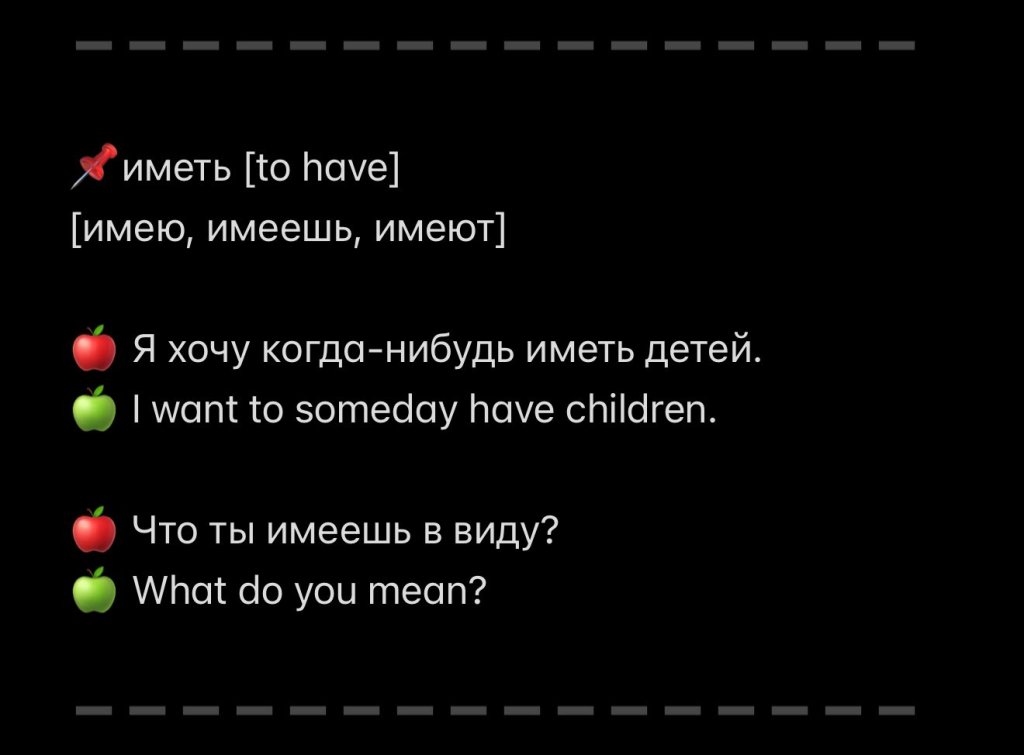
The most useful verb from this list is probably the verb иметь [to have].
Let’s conjugate it! It’s simple!
Remove -ть, giving us the stem име-. Next, add in the following endings:
| иметь [to have] |
| stem: име– |
| я | ты | он|она|оно | мы | вы | они |
| –ю | –ешь | –ет | –ем | –ете | –ют |
| Have you noticed that these verbs conjugate similarly to first-conjugation verbs? Just some slight differences. |
No post would be complete without example sentences.
| Что вы имеете в виду? What do you mean? |
| Мы имеем дело со сложными проблемами. We’re dealing with complex problems. |
| Все имеют право голосовать. Everyone has the right to vote. |
| The verb иметь means to have, but this verb is used in more limited contexts such as with modal verbs [to want]. It also is used with abstract nouns to create certain expressions: иметь удовольствие [to have the pleasure], иметь право [to have the right], иметь возможность [to have the opportunity]. |
| Additional verbs following this pattern are: уметь [to know how], бледнеть [to become pale], зеленеть [to become green], краснеть [to become red], темнеть [to become dark], светлеть [to become light], молодеть [to become younger], беднеть [to become poor], стареть [to become old] etc. |
| Мне уже за 30 лет, я старею. I’m already over 30 years old; I’m getting old. |
| Что Вы имеете в виду таким замечанием? What do you mean by that type of remark? |
| Она умеет кататься на лыжах. She can ski. (acquired skill) |
For more verb conjugation lessons, consult the Russian Grammar page on this blog.
Are you finding my blog useful?
Like and share the posts and subscribe to my blog please.
By doing so, you help it thrive and succeed.
That is all for today’s lesson! I hope this lesson proved to be useful to my readers.
See you next time!
 My Slavic Studies