| Introduction |
Reflexive verbs tend to be used more in Russian than in English. And their usages rarely coincide with each other. In other words, they aren’t used in the same way.
How do we tell a reflexive verb apart from a non-reflexive verb? Easy!
| All reflexive verbs end in –ся |
There is a lot to be said concerning verbs of this type, however, this post is mainly dedicated to its conjugation.
To learn its uses, a separate post will be written.
| Formation |
Conjugating reflexive verbs in Russian is nothing difficult! 🙂
You just add either –сь [vowel ending] or –ся [consonant ending] to the verb endings. But you conjugate the verb first! Let’s look at a reflexive verb.
For reference, and because we all love visuals:
| vowel ending | –сь |
| consonant ending | –ся |
Due to the nature of Russian verb conjugation [in the present tense], the conjugations for reflexive verbs should look like so:
| Reflexive Verb Endings [typical pattern] |
| я | ты | он/она/оно | мы | вы | они |
| –сь | –ся | –ся | –ся | –сь | –ся |
We’ll be using the verb ошибаться [to be mistaken, to be wrong]. This is a first-conjugation verb.
| ошибаться [to be mistaken, to be wrong] |
| ошибаюсь | ошибаемся |
| ошибаешься | ошибаетесь |
| ошибается | ошибаются |
As you see, I conjugated the verb, then added in the appropriate reflexive endings. After a vowel ending, add –сь. And after a consonant ending, add –ся.
| Никто не совершенен. Мы все ошибаемся. No one’s perfect. We all make mistakes. |
| Если я не ошибаюсь, твой дом на этой улице. If I’m not mistaken, your house is on this street. |
| Что касается этой темы, Вы ошибаетесь. Concerning this subject, you’re mistaken. |
Let’s look at another reflexive verb. The verb учиться [to study, to be a student, to learn]. This a second-conjugation verb.
| учиться [to study, to be a student, to learn] |
| учусь | учимся |
| учишься | учитесь |
| учится | учатся |
| Я учусь в государственном университете в Неваде. I study at a state university in Nevada. |
| Ты хорошо учишься. Молодец! You’re a good student. Good job! |
| Они больше не учатся. Окончили учёбу прошлой весной. They’re no longer students. They graduated last spring. |
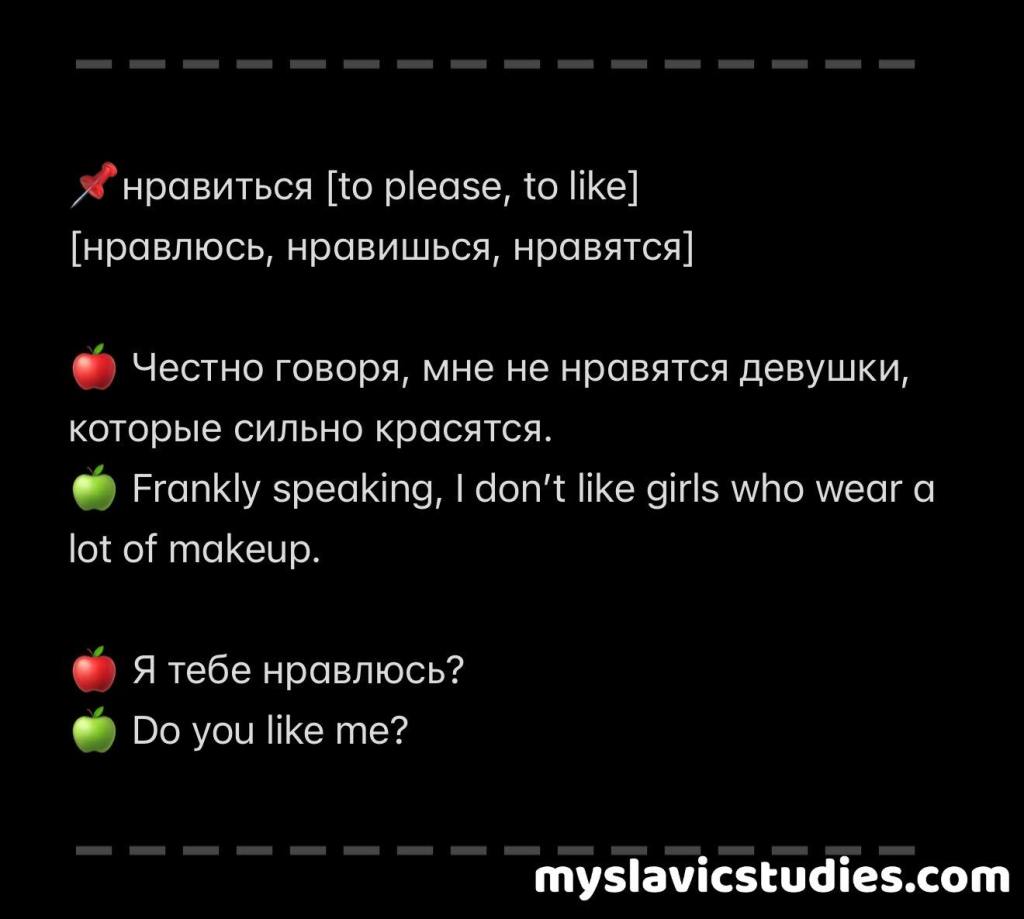
And now, before ending this lesson, let’s look at one more reflexive verb. The verb нравиться [to like, to please]. This is a highly used reflexive verb, but it can be confusing. The reason why is because what we consider the subject to be turns out to be the object.
Let’s look at it in more detail… after conjugating it!
| нравиться [to like, to please] |
| нравлюсь | нравимся |
| нравишься | нравитесь |
| нравится | нравятся |
Because of this verb’s nature, you’re going to be using either the third-person singular or plural [they are highlighted]. Yet, there will be times when the other forms are used. Let’s look at some examples for further clarity. Also, the object is in the dative case when using this verb.
| Мне нравится русский язык. I like the Russian language. [lit. To me the Russian language is pleasing.] |
| Мне нравятся славянские языки. I like Slavic languages. [lit. To me Slavic languages are pleasing.] |
In the above sentences, the Russian language and Slavic languages are the subjects. They are performing the action.
So, what if I wanted to say do you like me? Think about it!
| Я тебе нравлюсь? Do you like me? |
And what about I like you?
| Ты мне нравишься. I like you. |
What about nobody likes you?
| Ты никому не нравишься. Nobody likes you. |
Now, if you’re a Romance language speaker, this will be easy to understand. Because these languages have an equivalent to the verb нравиться.
| Almost every verb in Russian can be used reflexively. A small amount are used exclusively in the reflexive form [highlighted in pink down below]. Some even change meaning depending on whether or not they are reflexive. The verbs in the box below are verbs that are typically used reflexively. Those highlighted in pink, I repeat, are exclusively reflexive! |
Additional commonly used reflexive verbs include:
| жаловаться [to complain], гордиться [to be proud], приходиться [to have to, must], становиться [to become], являться [to be], заниматься [to occupy oneself, to study], интересоваться [to be interested], радоваться [to take pleasure in], фотографироваться [to have one’s photo taken], стесняться [to be shy], одеваться [to get dressed], отказываться [to reject], жениться [to marry], etc. |
Some example sentences utilizing these verbs:
| С замедлением экономики многим приходится сокращать расходы. With the economy slowing down, many have to cut expenses. |
| По утрам я одеваюсь, завтракаю и собираюсь на работу. In the mornings, I get dressed, have breakfast and get ready for work. |
| Мы с Женей женимся на следующей неделе. Zhenya and I are getting married next week. |


Well, that’s all! I hope this post proved to be useful to you.
| Last Edit: 01/19/2026. |
 My Slavic Studies